
With oil prices hovering at challenging lows, service providers and trucking companies in the oil and gas sector are feeling the squeeze. Margins are tight, overhead is high, and the pressure to deliver more with less has never been greater. At the same time, the cost of hiring qualified logistics personnel—dispatchers, coordinators, and support staff—continues to climb, especially when factoring in taxes, benefits, equipment, and recruiting fees.
That’s where nearshoring steps in as a smart, cost-effective solution. Companies like PetroHire are helping energy companies and field logistics providers slash workforce costs by tapping into a pool of highly skilled, bilingual professionals across Latin America—without sacrificing quality, time zone alignment, or communication clarity. Additionally, onshoring can help reduce operating expenses by outsourcing tasks to a different region within the same country, maintaining legal and cultural familiarity while benefiting from lower costs.
Introduction to Nearshoring
Definition and Benefits of Nearshoring
Nearshoring is a strategic outsourcing model that involves delegating tasks to neighboring or nearby countries with shared time zones or cultural similarities. This approach offers numerous benefits, including significant cost savings, improved communication, and increased collaboration. By hiring nearshore talent, businesses can tap into a vast talent pool of highly skilled professionals who share their working hours, understand cultural nuances, and speak the same language. Nearshoring is particularly beneficial for industries like oilfield logistics and services, where real-time collaboration and operational execution are crucial. This model ensures that businesses can maintain high-quality output while reducing overhead costs and improving operational efficiency.
***If your company is facing rising expenses and lower pricing, here are seven clear ways nearshoring your logistics roles throught PetroHire can dramatically improve your bottom line, and your operational execution.***
Using PetroHire to Build Your Nearshore Team
1. All-Inclusive, Predictable Monthly Pricing
One of the biggest financial headaches in traditional hiring is the uncertainty of total costs. Developing a robust hiring strategy that considers onshore, offshore, and nearshore options can help mitigate these uncertainties. Between salary, employment taxes, benefits, IT equipment, and bonuses, your payroll expenses often balloon well beyond the base wage.
Integrating nearshore teams with in-house operations is crucial for better collaboration and communication, ensuring cohesive team dynamics and seamless workflows.
PetroHire simplifies that with a single, all-inclusive monthly rate.
What’s included?
Salary & bonuses
Taxes
Recruiting & hiring
IT equipment
Onboarding
This model removes the surprise line items and gives you cost control from day one. It’s perfect for operators who want to scale without hidden fees or variable HR costs.

2. 30–40% Average Savings on Total Workforce Costs
The numbers don’t lie. According to PetroHire data, clients save an average of 30–40% when compared to traditional U.S.-based hiring.
Why?
Hiring a full-time internal logistics employee in the U.S. comes with all the following expenses:
Salary
FICA & unemployment taxes
Workers’ compensation
Health, dental, and life insurance
Short- and long-term disability
401(k) contributions
Equipment, IT, and onboarding
Facility costs
Hiring and recruiting fees
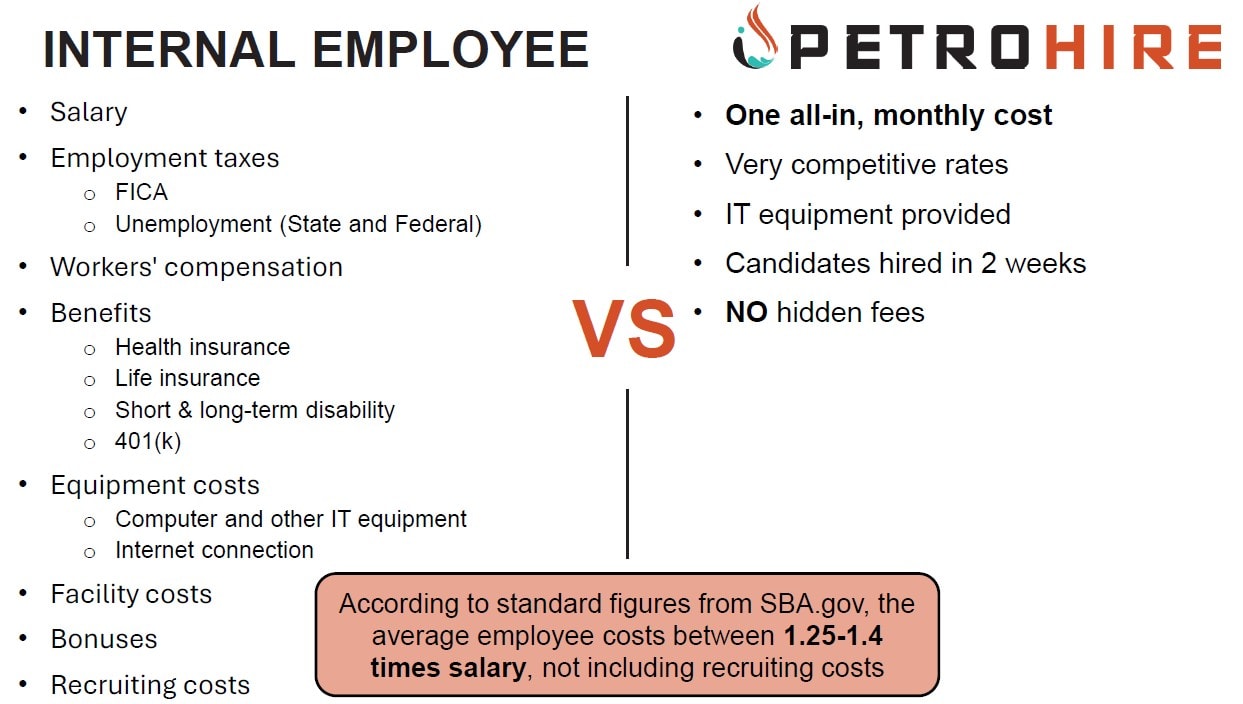
In fact, the SBA estimates that an employee costs 1.25 to 1.4 times their salary when all expenses are factored in—not including the $4,100 average per-hire cost reported by the Society of Human Resource Management (SHRM).
With PetroHire, you avoid all of that overhead and just pay one flat rate. And because it’s a nearshore model, you don’t sacrifice skill or time zone compatibility. Talent availability is a critical factor when considering nearshoring options, as it impacts costs and hiring timelines. Different nearshore markets offer unique strengths and talent availability, making it easier to find the right fit for your needs.
3. Zero Recruiting & Placement Fees
Recruiting isn’t just expensive—it’s time-consuming and unreliable. Recruiter fees typically range from 15–20% of a candidate’s annual salary, and that’s before you consider the internal time spent on screening, assessments, and interviews. Additionally, high employee turnover can lead to unexpected costs related to hiring and training new employees, as well as legal and administrative complexities, especially when working with international teams.
PetroHire eliminates this entirely.
Our process includes:
Job description intake
Candidate sourcing and vetting
Bilingual and cognitive assessments
Interview prep and coordination
Equipment setup
You don’t pay extra for any of this. And if the first candidate isn’t the right fit, we’ll help you find another—no replacement fees, no penalty.
It’s also important to consider software licenses as part of the overall infrastructure costs, which can accumulate additional expenses.
4. Faster Time-to-Hire Means Less Downtime
In oilfield logistics, every day of delay can cost thousands. Waiting weeks or months to fill a dispatch or operations role can stall your entire supply chain. Or worse, settling on a sub-par candidate because you’re desperate to keep your operations rolling.
PetroHire’s model is built for speed without sacrificing quality.
Candidates are sourced and screened within 2 weeks or less
Bilingual professionals are already vetted and matched by region
Final interviews are scheduled fast and efficiently
Once selected, candidates are ready to work—no long onboarding lag
This means you get boots-on-the-ground support much faster than traditional recruiting. Reduced downtime equals reduced lost revenue. Additionally, nearshoring can significantly lower labor costs compared to traditional U.S.-based hiring, providing a strategic balance between cost and quality.
Hiring nearshore developers offers cost-effective software development solutions, with quick access to skilled engineers who seamlessly integrate into your existing workflows.

5. Lower Risk and No Long-Term Commitments
Hiring internally always comes with long-term obligations—severance packages, benefits continuation, and the HR complexity of managing full-time staff. While hiring locally may seem advantageous, nearshoring presents a more cost-effective solution without sacrificing quality, especially given the rise of qualified professionals in LATAM countries.
Leveraging nearshore talent can significantly reduce recruiting and placement fees, providing a strategic advantage for businesses looking to optimize their hiring processes.
PetroHire flips that script.
With our model:
You’re not locked into long-term contracts
Only a 60-day notice is required if you need to replace or eliminate a role
You avoid the compliance headaches of cross-border employment
PetroHire manages the employment relationship, so you don’t have to
This flexibility lets you scale your team up or down based on demand, without the legal or financial weight of permanent hires.
6. Lower Turnover Costs with Vetted, Committed Nearshore Team
Turnover is one of the most overlooked expenses in the oilfield—and one of the most damaging.
Every time you lose a dispatcher, coordinator, or logistics specialist, the cost isn’t just in recruiting and rehiring. It’s also:
Lost productivity
Training time for replacements
Increased strain on remaining team members
Potential safety and communication issues
Minimizing time zone differences can significantly reduce delays and enhance real-time collaboration, leading to more efficient operations.
Having a dedicated team ensures faster turnaround times and better project outcomes by providing a stable, committed workforce that deeply understands the project needs.
According to the Society for Human Resource Management (SHRM), the average cost of replacing an employee can be 50–60% of their annual salary. In high-skill roles like oilfield logistics, it can be even higher.
How PetroHire Helps Reduce Turnover and Reduce Costs:
Rigorous Vetting: Only ~2% of applicants make it through PetroHire’s screening process. This means clients see better fit and longer retention. The rigorous vetting process also facilitates effective knowledge transfer, enhancing internal capabilities and reducing turnover costs.
Integrating nearshore teams with in-house staff is crucial for better collaboration and team cohesion, promoting shared cultural values and work styles to streamline processes.
Cultural Alignment: Candidates are bilingual and often familiar with U.S. culture, leading to smoother onboarding and stronger team cohesion. Flexibility: If a replacement is needed, PetroHire handles it at no extra cost—no backfill or placement fees. Commitment: PetroHire sources candidates looking for long-term roles, not short-term gigs. This minimizes churn and builds continuity.
By improving retention and absorbing replacement risks, PetroHire helps clients avoid one of the most painful—and expensive—parts of workforce management.
7. PetroHire Helps Find Ideal Candidates for Business Operations and Processes
Assessing Business Operations for Nearshoring
Assessing business operations is a critical step in implementing a nearshoring strategy. This involves identifying routine, time-intensive tasks that can be outsourced to nearshore teams. Businesses should also evaluate their current processes and determine which tasks can be handled by nearshore staff augmentation models. By doing so, companies can reduce costs, improve efficiency, and focus on core business activities. It’s essential to consider factors like cultural alignment, language, and time zone when nearshoring to ensure a smooth transition and successful collaboration. Careful planning and assessment can help businesses leverage the benefits of nearshoring, leading to continuous improvement and streamlined operations.
Final Thoughts: Why Nearshoring Works for Oil & Gas
From cost savings to flexibility, the case for nearshoring logistics talent through PetroHire is strong. They’re not just offering cheaper labor—they’re offering quality, vetted professionals who operate in U.S. time zones and speak fluent English and Spanish. By leveraging nearshore outsourcing, energy companies can streamline their business processes, improving efficiency and ensuring that operations remain aligned with growth objectives.
Nearshore outsourcing is a strategic model that allows companies to manage workloads flexibly while maintaining quality and oversight. For energy companies that want to stay lean, agile, and competitive, nearshoring is more than a trend—it’s a smart business strategy.
📞 Ready to learn more or get started? Visit www.petrohire.com or reach out directly to the team.